
Fragrance Notes Explained: How to Read Perfume Notes
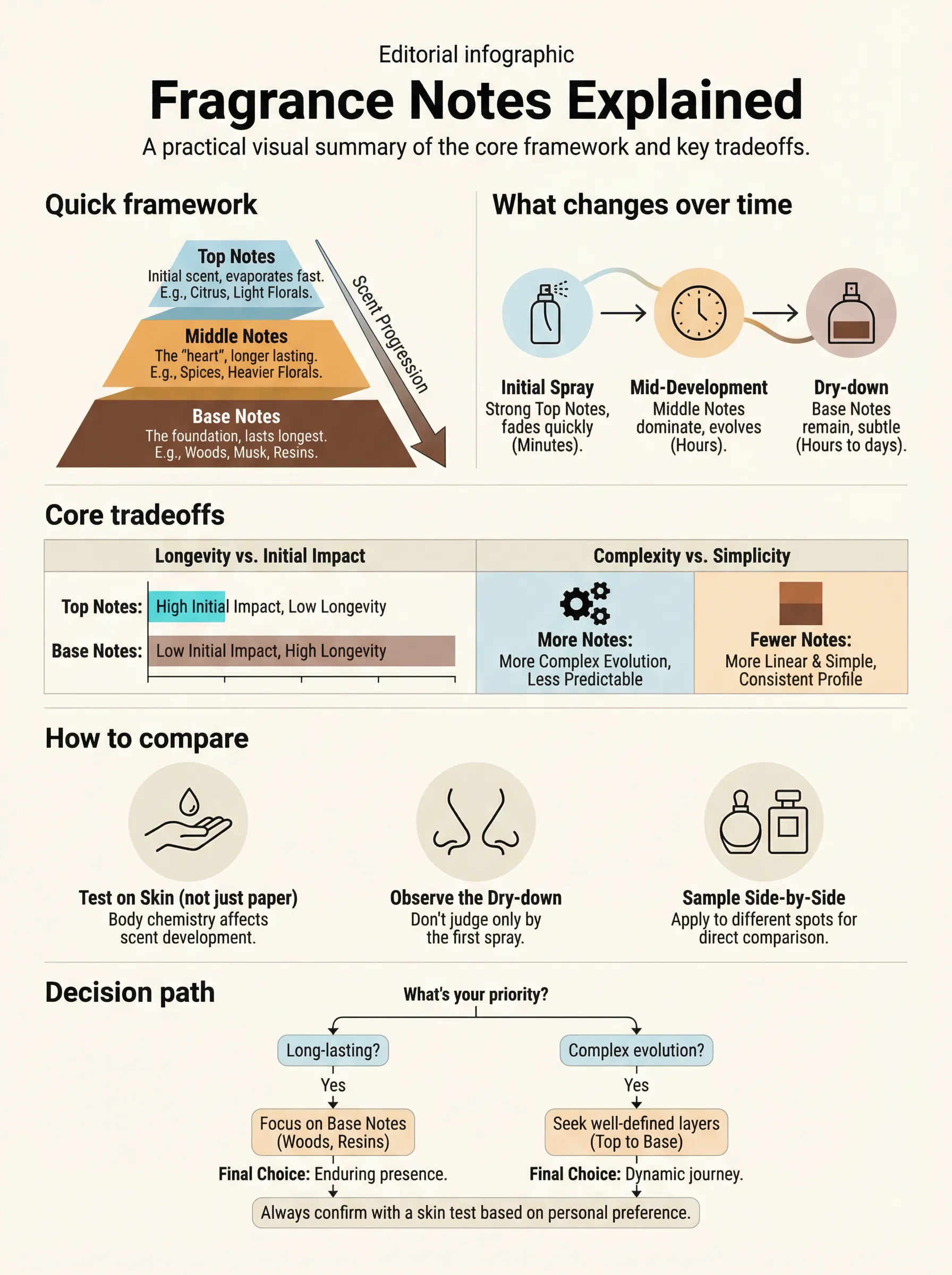
Fragrance notes explained starts with one correction: a note pyramid is not a promise of exactly what you will smell. It is a time-based sketch of how a perfume introduces itself, reveals its character, and settles into the part you will live with longest.
That matters because most bad perfume buys happen when people shop the opening and ignore the drydown. A bright citrus top can fade into woods you find harsh. A vanilla scent can wear airy, smoky, creamy, or dark depending on the middle and base around it. Two perfumes can share familiar notes and still feel nothing alike once the first ten minutes are gone.
Once you read notes as a pattern instead of a guarantee, perfume pages become much more useful. You can spot when a fresh opening is hiding a firmer woody finish, when a sweet profile is likely to feel dressed-up rather than sugary, and when a tester, mini, or smaller format is the smarter first move.
Most note lists describe structure, not a guaranteed smell
People usually search for fragrance notes explained because they want a cleaner answer than perfume marketing usually gives them. They do not really want a glossary. They want to know whether the notes on a product page can save them from buying the wrong bottle. The honest answer is yes, but only if you stop treating notes as a literal smell guarantee.
That is the first buying stake. Notes can predict direction, timing, contrast, and likely mood. They can tell you whether a fragrance probably opens bright, cool, plush, peppery, clean, dark, juicy, creamy, or dry. They can suggest whether the heart leans floral, aromatic, spicy, fruity, powdery, or abstract. They can warn you that the base may turn woody, musky, resinous, sweet, smoky, or clean for hours. What they cannot do is promise the exact smell print you will experience minute by minute. Sources that approach perfume from different angles keep landing on that same point: Britannica frames perfume as an art of blended aromatic materials, PMC's perfume engineering review explains why materials register differently over time, and PerfumeWorkbench is especially blunt that the fragrance pyramid is a customer-facing representation of a formula, not the formula itself.
Most buyers misread notes for a simple reason: the words look concrete, so they feel more predictive than they really are. Bergamot sounds like bergamot. Vanilla sounds like vanilla. Rose sounds like rose. Oud sounds heavy. But perfume is not a row of isolated objects. It is composition, emphasis, timing, and texture. A note list is a simplified communication layer placed on top of that composition.
A fast way to hold that tension in your head is to separate what notes can do from what they cannot do.
| Notes can help predict | Notes cannot reliably promise |
|---|---|
| Whether the opening reads bright, juicy, green, spicy, or soft | The exact smell you will get at every minute of wear |
| Whether the middle note leans floral, aromatic, creamy, fruity, or abstract | Whether a favorite note will behave the way it did in another perfume |
| Whether the base is likely to become woody, musky, sweet, smoky, or resinous | Whether shared notes mean shared character |
| Whether a perfume sounds easier for daytime or richer for evening | Whether the fragrance will feel balanced to you in every setting |
| Whether the structure suggests low, medium, or high blind-buy risk | Whether a note finder or chart can replace smelling the drydown |
That difference is where most money is either saved or wasted. A buyer who reads top, middle, and base as a movement through time gets a shortlist. A buyer who reads them as a fixed ingredient list gets surprised later. The opening is the invitation. The middle note is where the style becomes legible. The base is the part you actually have to live with. When those three jobs are blurred together, even an accurate note list becomes easy to misuse.
That is why a long fragrance notes list is not automatically more helpful than a short one. A crowded page can feel informative while still hiding the only question you care about: what kind of wear does this turn into after the opening charm is gone? Coffee, vanilla, and white flowers already tell a sharper story than ten scattered notes with no hierarchy. Bergamot, aromatics, and woody amber do too. Marine freshness with patchouli does too. The useful move is not collecting every noun. It is identifying which notes seem to carry the perfume's personality and which ones are probably just support.
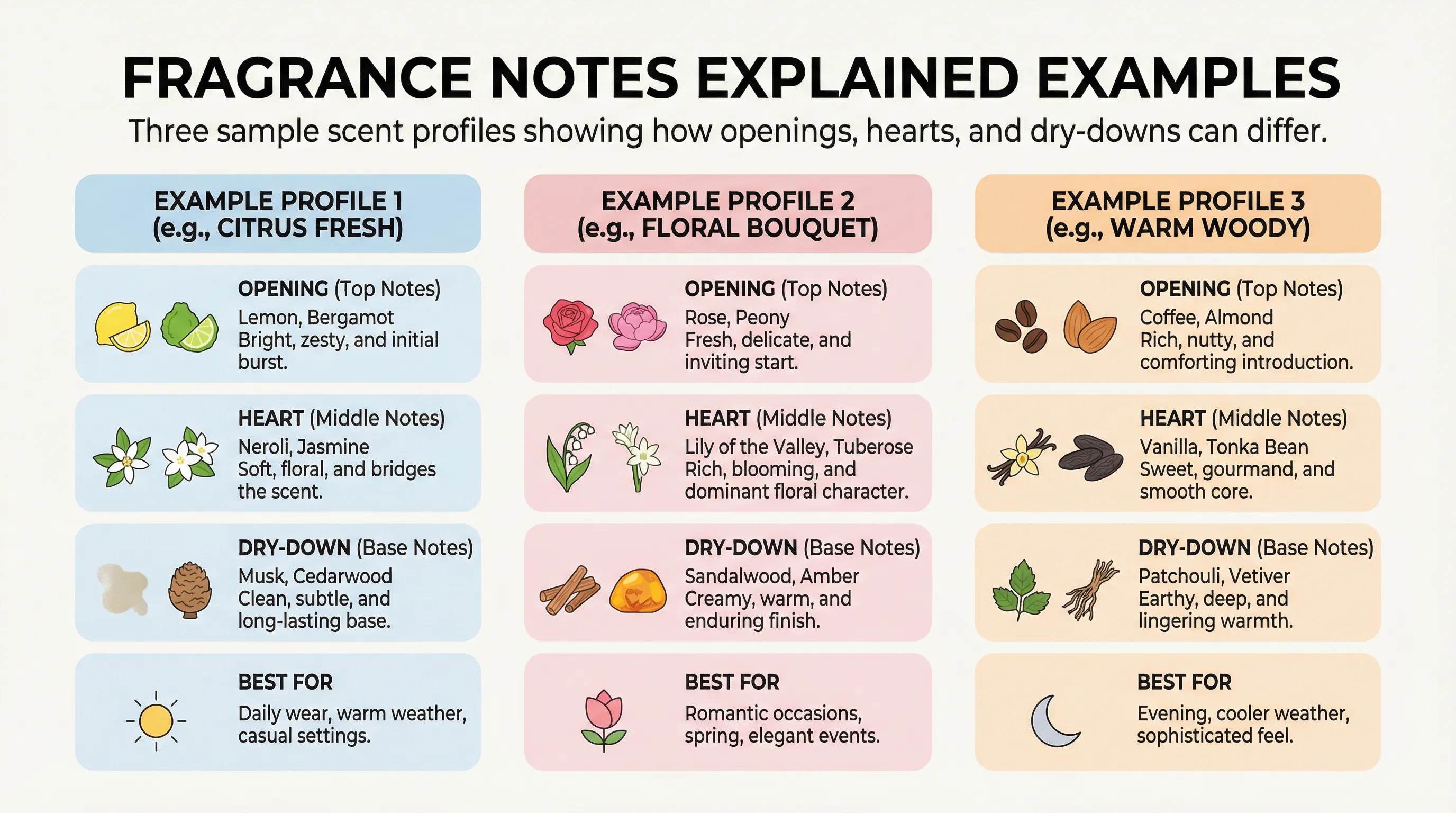
Vanilla is the fastest way to see the problem. Vanilla next to coffee and white flowers often signals an evening scent with contrast and attitude. Vanilla next to orange blossom and musk can read cleaner, softer, or more sensual than edible. Vanilla next to iris and woods can feel cosmetic, smooth, and tailored. The note name stays the same. The wearing result does not.
Citrus gives buyers the same false confidence. Bergamot with marine accords and patchouli does not behave like bergamot with lavender and amber woods, and neither one behaves like bergamot with neroli and musk. When shoppers ask what are top notes in perfume, they often expect a list of ingredients. The more useful answer is this: top notes are the shortest-lived part of a larger sales pitch. They matter, but they are not the full argument.
Consumer-facing pyramids are also selective. They are meant to communicate, not disclose every material in exhaustive detail. CandleScience's fragrance note glossary is useful because it keeps the vocabulary clear, but it also reinforces a bigger truth: note language is simplified language. It helps you categorize scent impressions. It does not reveal every structural decision inside the formula.
A paraphrased technical takeaway from PMC's perfume engineering review helps anchor the whole subject: perfume is best understood as an evolving pattern of evaporation and perception, not as a flat list of ingredients. That is why notes work best as a time map.
Once that correction clicks, buying behavior changes immediately. Instead of asking whether you like a note in the abstract, you start asking what the structure is likely to become after the first ten minutes. Instead of rewarding the page with the most notes, you reward the one that reveals a clear shape. Instead of assuming a sweet note means sweetness all day, you look for whether the sweetness is supported by coffee, musk, woods, amber, florals, or spice. Instead of assuming a fresh opening means an easy scent, you ask whether the base might still end up dry, woody, mineral, or sharp.
That is the practical stake: notes are a directional tool for narrowing a shortlist, not a machine for perfect prediction. Once you accept that, every later decision gets better. You stop buying the opening and start evaluating the full arc.
Source note: A note pyramid is an explanatory model and should not be treated as a perfect formula map or exhaustive prediction of how a fragrance will behave. Source: Perfume Workbench · How to Build a Fragrance Pyramid That Actually Reflects Your Formula
If you want to turn note reading into a real buying decision, check bottle size first with 3.3 oz to ml perfume. If the warm, resinous side of this guide is the part that actually sounds right, move into Arabian perfumes rather than another abstract notes list.


Wholesale next step
Sign up to unlock wholesale pricing so you can compare the shortlist inside your buyer account instead of guessing from the public catalog alone.
Need a fast second opinion before you commit? Chat on WhatsApp, contact us by email, or contact us here.
Top, heart, and base tell you when a perfume makes its case
When people ask what are top middle and base notes in perfume, they are usually handed a neat classroom answer and left alone with the real problem. The real problem is not memorizing the three layers. It is knowing how much trust to give each layer before you spend money.
The cleanest way to read the pyramid is through timing. Top notes win your attention. The heart tells you what kind of fragrance it actually wants to be. The base decides whether you will still enjoy wearing it after the first impression has worn off.
That does not mean every perfume unfolds in dramatic cinematic stages. Some are fairly linear. Some feel blended from the start. Some compress transitions so tightly that the opening and heart almost arrive together. But the top-heart-base model remains useful because it helps you assign the right amount of skepticism to the right moment.
Top notes are the greeting, not the relationship. Top notes are the first part of the fragrance that reaches you clearly after application. In practical perfume language, that often means citrus, herbs, pepper, light fruit, or airy aromatics. If your scent vocabulary comes from home fragrance or essential-oil education, the idea will sound familiar; people often encounter the same principle through phrases like top notes essential oils, where lift and immediacy are the point.
The problem is that top notes are very easy to love and very easy to overvalue. Grapefruit feels lively. Bergamot feels clean. Lavender feels crisp. Mint feels cool. Pepper adds instant shape. That is why paper strips and first sprays sell bottles that later become occasional wear instead of favorites. The top is built to charm quickly.
A bright opening may still be sitting on a darker woody base. A fruity top may be covering patchouli or a warmer amber structure. A sparkling citrus start may not mean the perfume stays breezy. When someone reads bergamot and assumes the entire fragrance will stay fresh all day, the error is not in the note list. The error is in mistaking the greeting for the whole personality.
The middle note is where style becomes legible. The heart matters more than many buyers realize because it is where a fragrance usually starts behaving like itself. This phase is where florals, spices, teas, aromatics, fruits, greens, or creamy facets settle into place and tell you what kind of wearer the scent imagines.
That makes the middle note more important than beginner explanations usually admit. The heart answers a stylistic question. Is the perfume trying to feel romantic, tailored, plush, transparent, barbershop-clean, softly feminine, spicy, moody, energetic, or a little strange? That answer usually becomes readable here.
Two fragrances can share bergamot on top and then split completely once the heart arrives. Bergamot followed by lavender and dry aromatics points toward a different life than bergamot followed by orange blossom and creamy sweetness. The opening did not lie. It simply did not finish the sentence.
A good real-world example is Black Opium Eau de Parfum. The official page does not frame it as generic vanilla sweetness. Coffee, vanilla, and white flowers together create a middle that feels nocturnal, polished, and high-contrast. That heart-stage tension keeps it from becoming a simple dessert read.
The base decides whether you keep wearing it. Base notes are where the fragrance stops performing for the counter and starts living on skin, fabric, and memory. Woods, musks, amber materials, patchouli, tonka, vanilla, balsams, and resins often show up here because the base is where persistence, comfort, and fatigue become real.
This is the layer buyers underrate most. If the base sounds wrong, the opening rarely rescues the bottle. A beautiful first spray does not make a sharp woody drydown gentler. A pretty floral start does not change the fact that you may tire of the sweet musky finish. A marine opening does not matter much if the later wear turns earthier than you enjoy.
That is why the base is the best filter in blind-buy situations. If the late wear sounds squarely outside your comfort zone, believe that warning. The fragrance you pay for is rarely the first spray alone. The opening gets attention. The base gets ownership.
Baccarat Rouge 540 is a useful case because internet shorthand often collapses it into generic sweetness. The official Maison Francis Kurkdjian collection page positions the fragrance around radiance, warmth, and signature presence rather than syrupy heaviness. That matters because a buyer who shops it like a dense gourmand is already reading the late wear incorrectly.
Once top, heart, and base are read in time instead of as three isolated buckets, the entire pyramid becomes more valuable. The question stops being which notes are listed and becomes which stage is doing the seducing, which stage reveals the personality, and which stage you actually have to live with.
Source note: Source-backed support available from candlescience.com for fragrance-notes coverage. Source: candlescience.com · Fragrance Note Glossary - CandleScience Compare Maison Francis Kurkdjian Baccarat Rouge 540 1.2 Extrait, tester options.
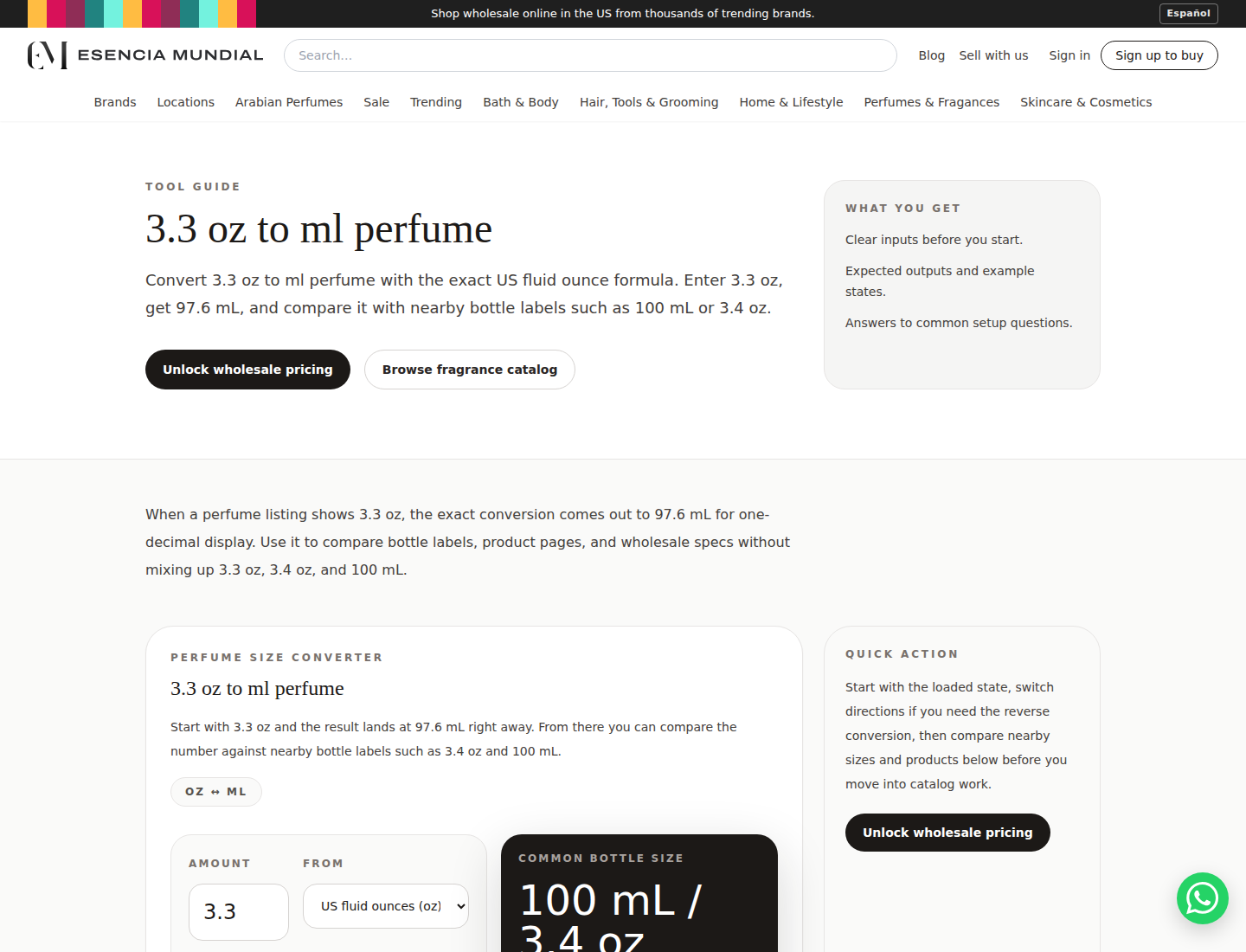
If the structure looks promising but you still do not trust the drydown, treat size as part of the risk. Compare common bottle sizes before you pay for more volume than your confidence justifies.
How to compare perfume notes without overreading them
People do not need a bigger fragrance notes chart nearly as much as they need a repeatable way to turn note language into a risk assessment. A fragrance notes finder or perfume notes finder can still be useful, but only after you know how to interpret what it surfaces.
Here is a practical reading method that works better than note collecting.
1. Start with the base, not the headline. If patchouli, dense amber, smoky woods, syrupy vanilla, leathery accords, or oud usually wear too heavy on you, begin there. The base tells you what stays longest. 2. Compress the opening into one mood. Instead of hoarding five top-note nouns, reduce them to a single impression: bright citrus, green aromatic, juicy fruit, peppery fresh, soft powder, or dark spice. 3. Find the tension pair. Coffee plus white flowers, saffron warmth plus radiant woods, marine freshness plus patchouli, rose plus oud, orange blossom plus musk. The contrast pair often predicts personality more accurately than the full list. 4. Translate notes into texture. Ask whether the structure sounds crisp, creamy, translucent, syrupy, dusty, smooth, plush, dry, soapy, metallic, or resinous. Texture is closer to lived wear than raw note words. 5. Place the fragrance in a real setting. Office, humid heat, evening wear, travel, close-contact use, and all-day casual wear ask different things from the drydown. 6. Match the format to the remaining uncertainty. If the drydown is still the question, move toward a tester or mini. If the structure already sounds familiar and the only unresolved issue is bottle size, a full bottle may be reasonable, especially after checking the 3.3 oz to ml perfume converter.
That method works because it makes the page answer the only questions that matter. Not which ingredients are named, but what you are likely to notice first, what will define the middle, and what stays on you long enough to shape ownership.
A compact scoring view makes the method faster.
| Structure on the page | First read | Drydown risk | Confidence without smelling | Smarter move |
|---|---|---|---|---|
| Citrus, aromatics, clean woods, musk | Fresh and versatile | Can turn sharper or woodier than expected | Medium | Tester if you dislike firm woody finishes |
| Coffee, vanilla, white flowers | Sweet with dark contrast | Can wear louder and richer than the word vanilla suggests | Medium-low | Tester or mini |
| Warm saffron-like brightness, florals, radiant woods | Warm, glowing, persistent | Can feel more abstract than shoppers expect | Medium-low | Tester first |
| Marine citrus, green aromatics, patchouli | Clean opening with depth underneath | May dry greener or earthier than the first spray suggests | Medium | Wear twice before full size |
| Rose, oud, amber | Rich and committed | Can be more resinous than a floral buyer wants | Low for beginners | Mini or smaller format |
| Orange blossom, musk, vanilla | White floral that can swing clean or sensual | Can dry creamier or sweeter than the opening implies | Medium | Compare official copy, then sample |
A short checklist helps even more when two pages look similar.
- If the base includes materials you often tire of, do not let the top talk you out of that concern.
- If the top and heart feel familiar but the base is new territory, lower your commitment.
- If the contrast pair sounds exactly like the style you usually enjoy, confidence rises even if the full list is long.
- If the page sounds vague but the structure feels coherent, trust the structure more than the adjectives.
- If the page lists many notes without revealing which tension drives the scent, read that as unresolved rather than luxurious.
A realistic example makes the method concrete. Imagine choosing between a coffee-vanilla floral, a marine-fresh woody scent, and a warm radiant amber signature for three different purposes: daily office wear, a night out, and travel. A beginner may fixate on one favorite word and say vanilla sounds safest because it feels familiar. A stronger reader asks better questions. Which base is easiest to live with for hours? Which middle note fits the situations you actually dress for? Which structure still contains the most uncertainty even after you read the page carefully? Suddenly the choice becomes about risk and fit rather than fantasy.
That is also the moment when smaller formats stop looking like hesitation and start looking like discipline. If the structure looks promising but the drydown still feels uncertain, browsing tester options is sensible. If the fragrance needs several wears across different settings, mini sizes are the smarter move. If the structure already lines up with your history and the only unresolved issue is quantity, the bottle-size tool solves a real problem instead of a decorative one.
The broader Perfumes & Fragrances category becomes more useful once you read patterns instead of isolated notes. The same is true of catalog search: typing vanilla into a search bar gives you chaos, while typing with a pattern in mind gives you a shortlist.
Several approved sources support this reading habit from different angles. FragranceX gives a clear consumer explanation of note timing. CandleScience clarifies the vocabulary without overcomplicating it. PerfumeWorkbench adds the trade-side reminder that the pyramid is interpretive communication, not lab disclosure. Together they point to the same conclusion: notes are best used for shortlisting and comparison, not perfect prediction.
A simple timeline of opening, middle, and base beside a four-axis matrix of freshness, sweetness, density, and drydown firmness would make the method even more legible because it shows why two perfumes with one shared note can still belong on opposite ends of the shortlist.
Compare Christian Dior Sauvage EDP 3.4 oz, mini sizes.
If the structure looks promising but you still do not trust the drydown, treat size as part of the risk. Compare common bottle sizes before you pay for more volume than your confidence justifies.
Four famous perfumes prove the pyramid is only the start
A reading method is only worth trusting if it survives contact with recognizable bottles. Named examples matter because they force note theory to do real work. They also expose how lazy shorthand can flatten fragrances that have very different arcs.
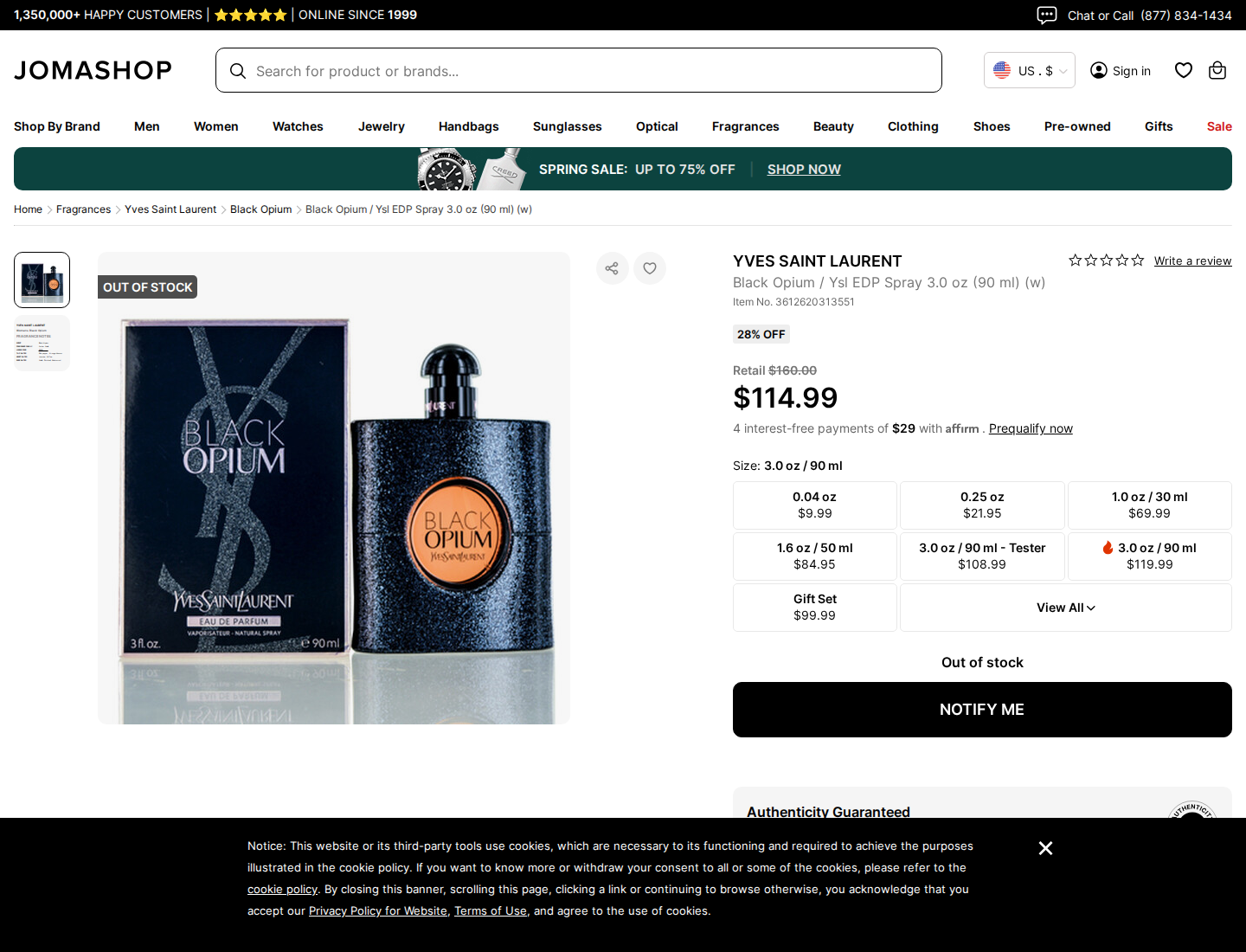
Black Opium, Baccarat Rouge 540, Dior Sauvage, and Acqua di Gio side by side. Start withBlack Opium Eau de Parfum, which you can also inspect through a live first-party listing at Yves Saint Laurent Black Opium Women EDP 3 oz. The official page foregrounds coffee, vanilla, and white flowers, and that already tells you more than a giant decorative pyramid might. The opening hints at sweetness, but the middle introduces contrast, so the fragrance does not read as simple sugar. The base matters because the sweetness is not casual or cozy. It is styled, evening-leaning, and clearly more polished than the word vanilla alone would suggest. What this proves for the buying decision is simple: if you like sweetness with edge, the structure is promising. If you like vanilla only when it stays soft, creamy, and comforting, the page is already giving you a warning.
Now compare that to Baccarat Rouge 540, which also appears in live inventory through the Maison Francis Kurkdjian Baccarat Rouge 540 1.2 Extrait. This is one of the clearest examples of why internet shorthand damages buying decisions. People often approach it expecting obvious candy-like sweetness because that is easy to repeat. The official collection language points somewhere more nuanced: radiance, warmth, and signature presence. Read that against the fragrance's reputation for glow rather than dessert density, and the structure begins to look less like pastry and more like a luminous warm aura. The lesson is not just that the perfume is famous. It is that warm and sweet-adjacent can still mean airy, abstract, and highly diffusive rather than creamy and edible.
Now move into the fresh category with Dior Sauvage as a live catalog example and the related Dior Sauvage EDP 3.4 oz. Readers often approach this family as if fresh automatically means simple or safe. It does not. The opening does what modern fresh designer openings do well: it feels instantly put together. The middle keeps the profile controlled rather than watery. The later wear usually matters most because buyers either like that firmer, more assertive fresh spine or realize they wanted something softer. What this proves is that bright openings can still belong to fragrances with attitude, projection, and a modern woody backbone. If you love freshness but tire of sharper drydowns, the strip will flatter you more than the full wear. If you want freshness that holds its shape, the same pattern becomes a positive signal.
Armani Acqua di Gio Eau de Parfum 6.7 oz gives you a different kind of fresh promise. The marine-citrus language around this family can tempt buyers to assume the entire wear will stay breezy and weightless. In practice, what makes a fragrance in this lane satisfying is usually the way freshness is carried into the later stages with enough depth to remain polished rather than watery. The opening catches attention with clarity and ease. The heart tells you whether the profile stays relaxed or begins to show more shape. The base determines whether the marine impression vanishes into nothing or settles into a grounded all-day option. The lesson is that aquatic freshness is not automatically flimsy, but it is also not the same as an ultra-airy skin scent.
Seen together, the four examples prove something much more useful than another top notes perfume list. Black Opium and Baccarat Rouge 540 can both be lazily called sweet, yet one leans into dark coffee-floral contrast while the other often reads as radiant, warm, and more abstract. Dior Sauvage and Acqua di Gio can both be filed under fresh, yet one suits buyers who want freshness with a stronger modern spine, while the other better suits buyers chasing marine ease with enough depth to last.
A side-by-side read of opening, middle, and base makes the difference even sharper.
| Perfume | Opening impression | Middle note story | Base and drydown lesson | Best reader takeaway |
|---|---|---|---|---|
| Black Opium Eau de Parfum | Sweet, glossy, immediately styled | Coffee and white flowers create contrast, not softness alone | The drydown keeps the profile dressed-up and richer than the word vanilla suggests | Good for buyers who want sweetness with edge |
| Baccarat Rouge 540 | Warm glow more than obvious dessert | The center feels radiant and signature-driven rather than cozy | The late wear is about aura and persistence, not simple syrupy heaviness | Good for buyers who want warm projection without a literal gourmand feel |
| Dior Sauvage family | Bright, brisk, modern freshness | The middle keeps control and presence rather than dissolving | The base is where the fresh-woody backbone either wins you or loses you | Good for buyers who want freshness that keeps structure |
| Acqua di Gio Eau de Parfum | Marine ease and clarity | The middle keeps the scent polished rather than flat | The base decides whether the freshness feels substantial enough for daily wear | Good for buyers who want aquatic freshness with staying power |
That is the level where note reading becomes decision-ready. Not which bottle has bergamot or vanilla, but which one opens charmingly and then darkens, which one starts sweet but keeps air in the structure, which one stays clean all the way through, and which one hides its heft until later.
Put the official Black Opium and Baccarat Rouge 540 product pages side by side and the contrast becomes visible before you ever spray either one. Do the same with Dior Sauvage and Acqua di Gio, and the word fresh immediately starts splitting into two very different buying paths.
Compare Yves Saint Laurent Opium Eau de Toilette 3 Ounce For Women, Perfumes & Fragrances.
If the structure looks promising but you still do not trust the drydown, treat size as part of the risk. Compare common bottle sizes before you pay for more volume than your confidence justifies.
Certain note pairings reveal style faster than a long list ever will
Once single-note thinking falls away, pairings become the fastest way to read personality. Pairings reveal tension, and tension is often what makes a fragrance feel expensive, memorable, safe, polarizing, dressed, or casual.
Coffee plus vanilla plus white flowers is a perfect example. Those words do not simply say sweet. They say sweet with shadow, lift, and polish. Coffee roughens the sweetness just enough. White flowers keep the structure from collapsing into literal dessert. Vanilla rounds the composition. That is why a fragrance like Black Opium reads more like an evening signature than a playful sugar scent.
Warm saffron-like brightness plus florals plus radiant woods teaches a different lesson. It points toward warmth with air inside it. Readers who see amber or sweetness nearby and expect plush density may miss the fact that radiant woods can create a more glowing effect. That is part of what makes Baccarat Rouge 540 such a useful case study. It reminds shoppers that warm fragrances do not all sit in one bucket. Warm can be syrupy, creamy, balsamic, smoky, translucent, halo-like, or quietly forceful.
Bergamot plus aromatics plus woody amber is another pattern worth learning because it often defines the modern fresh-woody designer lane. The structure signals more than cleanliness. It signals freshness with shape, projection, and a firmer finish than the opening alone suggests. Readers who love bright openings but fatigue on sharper modern drydowns should slow down when they see it. Readers who specifically want freshness that does not dissolve into nothing should treat the same combination as a green light.
Marine freshness plus patchouli or mineral woods is equally important because it explains why some aquatic fragrances feel more substantial than their first spray suggests. Shoppers often misread marine language as a guarantee of effortless breeziness. In reality, marine structures can become grounded, slightly earthy, green, or mineral later on. That is often the difference between a pleasant opening and a fragrance that can actually hold up through a full day.
Rose plus oud plus amber remains one of the clearest high-commitment pairings in perfumery. Before you know exact proportions, the structure already tells you the fragrance is probably aiming for presence, texture, and depth rather than transparency. That does not make it difficult by default. It makes it more committed. Readers who are exploring richer profiles in that lane are often better served by browsing a tighter family such as Arabian perfumes than by jumping between unrelated categories.
Orange blossom or neroli plus musk plus vanilla teaches a subtler lesson. The structure can swing in two directions. If the musk is clean and the sweetness is restrained, the result may feel polished and crisp. If the vanilla is creamier and the woods are warmer, the same family can turn much more sensual. White-floral shoppers get into trouble here because they often decide too early that a fragrance is either clean or loud before they see what the balancing materials are doing.
A long fragrance notes list rarely makes these relationships obvious because it invites equal weighting of every term. Pairings force hierarchy. They ask which contrast the fragrance is actually built on. That question is much closer to how experienced fragrance shoppers think, whether or not they use that language.
The same logic improves digital searching. A perfume notes finder is good at surfacing overlap. It is not good at explaining context. Search only for vanilla, and you may compare bottles whose personalities have almost nothing in common. Search for vanilla with coffee, vanilla with orange blossom, vanilla with musk, or vanilla with patchouli, and suddenly the shortlist becomes far more human.
For readers who want a quick working reference, this compact comparison is more useful than a giant alphabetical chart.
| Pairing | What it tends to signal | Common misread |
|---|---|---|
| Coffee + vanilla + white flowers | Dark sweetness with lift and polish | Assuming vanilla means cozy softness |
| Warm florals + radiant woods | Persistent warmth with air and glow | Assuming warm means dense gourmand |
| Bergamot + lavender or aromatics + woody amber | Freshness with structure and presence | Assuming fresh means light and easy all day |
| Marine notes + patchouli or mineral woods | Clean opening with grounded finish | Assuming aquatic means breezy the whole time |
| Rose + oud + amber | Plush, textured, high-commitment profile | Assuming rose keeps the scent soft |
| Orange blossom + musk + vanilla | White floral that can read clean or sensual | Assuming floral equals one fixed style |
General vocabulary references help here, but only when they keep the reading disciplined rather than overconfident. CandleScience helps define the terms. PerfumeWorkbench helps keep expectations realistic. That combination is exactly what readers need: enough vocabulary to recognize patterns, and enough restraint not to confuse a pattern with certainty.
Compare 3.3 oz to ml perfume, Amyris Homme By Maison Francis Kurkdjian For Men EDT 1.2 oz.
Official product pages, concentration, and bottle format tell a fuller story
A good official product page is not just marketing gloss sprayed over a notes list. It usually reveals what the brand considers the center of gravity. That matters because note charts flatten importance. They can make a support note look as significant as the accord the house actually wants you to remember.
That is one reason the YSL Beauty Black Opium page is so instructive. It does not try to impress the reader with encyclopedic detail. It foregrounds a dark coffee-vanilla-white-floral identity. Whether that sounds appealing or not, it is commercially honest in the best sense. It tells the right buyer to lean in and gives the wrong buyer permission to walk away before the bottle becomes an expensive experiment.
The Maison Francis Kurkdjian Baccarat Rouge 540 page teaches the complementary lesson. The language around the fragrance does not let internet shorthand define it. It emphasizes radiance and signature character. That matters because official language often corrects the simplifications that start circulating once a perfume becomes famous.
Databases help too, but they serve a different job. A community catalog like Fragrantica's Black Opium entry is useful for seeing how a well-known perfume gets summarized at scale. The value is not that it replaces the official page. The value is that it shows how quickly a nuanced structure can collapse into a few repeated ideas. When the official surface and a catalog summary agree, confidence rises. When they diverge, the divergence itself becomes useful evidence.
That same triangulation works with live retail surfaces. Compare the official page, a catalog summary, and a real in-stock listing from our fragrance brands or a product result surfaced through catalog search, and the note list starts behaving less like decoration and more like a buying signal. One source gives the brand's emphasis. Another shows how the public summarizes it. A live listing shows whether the fragrance is even realistically available in the size or format you want.
Concentration changes emphasis more than shoppers expect. Concentration language is one of the most abused shortcuts in fragrance buying. Eau de Toilette, Eau de Parfum, Parfum, and Extrait do not form a universal ladder where higher concentration simply means stronger, better, sweeter, or more luxurious. In practice, concentration often changes emphasis.
A more concentrated version may be denser, but it may also be smoother, darker, warmer, less sparkling, or simply more focused in a different part of the accord. That matters because the exact same fragrance family can shift its center of gravity across concentrations. The fresher parts may be softened. The sweeter parts may be deepened. The woods may feel rounder. The opening may become quieter while the base becomes more commanding.
Readers who compare only by note list and ignore concentration language miss a large part of the wearing experience before they ever spray the bottle. Brand language such as intense, parfum, extrait, luminous, fresh, or signature may not be scientific, but it still tells you which part of the fragrance the house wants to push forward. When that language aligns with the note structure, you get a far better sense of whether the scent will stay bright, turn smoother, feel sweeter, or settle more heavily.
Bottle format belongs in the same conversation because format is strategy. Once notes and concentration tell you what kind of uncertainty remains, format tells you how much money needs to be attached to that uncertainty. If the structure is attractive but the drydown may still go too dense, a tester is rational. If the profile feels context-sensitive, a mini is rational. If the family is already proven territory and the only problem is volume math, the decision shifts from identity to size.
That is where the 3.3 oz to ml perfume tool becomes genuinely useful. It belongs late in the process, not early. You reach for it when the fragrance already makes sense and the open question is format, bottle planning, or comparison across listings.
The first-party product surfaces become stronger once you reach this stage because they turn note reading into live choices. Readers comparing the Yves Saint Laurent Black Opium Women EDP 3 oz, the Baccarat Rouge 540 Extrait listing, the Dior Sauvage EDP 3.4 oz, and the Armani Acqua di Gio Eau de Parfum 6.7 oz are no longer just reading note pyramids. They are deciding whether the structure, concentration, and risk justify a tester, a mini, or a full bottle.
Even a screenshot of the official Black Opium page beside the official Baccarat Rouge 540 page would teach a practical lesson: brands often give you enough emphasis clues to avoid reading the note list too literally if you slow down and notice what they choose to foreground.
From here, continue with Maison Fk Baccarat Rouge 540 1.2 Unisex France 27pcs Bybox Unisex EDP, Arabian Perfumes.
Expensive mistakes start when the note list is read too literally
Most fragrance mistakes are not failures of taste. They are failures of interpretation. Buyers usually do not regret a bottle because they missed some obscure technical detail. They regret it because they believed the top notes were the whole story, because they treated one favorite note as a guarantee, or because they let a familiar category word do too much work.
The first expensive mistake is buying the opening and wearing the base. This is the oldest trap because it feels completely reasonable. A perfume opens with citrus, herbs, pepper, or juicy fruit and immediately seems clean, bright, easy, and safe. Hours later the woods, amber, musk, vanilla, or patchouli become the actual experience, and the bottle that felt perfect in the first spray becomes hard to reach for at home.
The second mistake is assuming one beloved note behaves the same way everywhere. Vanilla can be airy, creamy, smoky, polished, cosmetic, syrupy, woody, or dark depending on the structure around it. Rose does the same thing. So do orange blossom, musk, amber, patchouli, and oud. Shared notes are not shared outcomes.
The third mistake is assuming shared notes mean shared smell. Two perfumes can list bergamot, florals, and woods and still feel miles apart because proportion, contrast, and accord design matter. The technical perspective in PMC helps explain why timing and composition change perception. A list alone cannot show final balance.
The fourth mistake is ignoring the contrast note because your favorite note looks dominant on the page. Someone chasing vanilla may overlook patchouli and then wonder why the perfume feels darker than expected. Someone hunting rose may ignore oud and amber and later discover the fragrance is far richer than the imagined soft floral. Someone wanting aquatic freshness may ignore the woods and later decide the scent feels firmer than the opening promised.
The fifth mistake is treating omissions as proof of absence. Consumer-facing pyramids are selective by design. PerfumeWorkbench is useful here because it reminds readers that the pyramid reflects the formula for communication, not as exhaustive disclosure. If a page lists only a few notes, that may signal editorial focus rather than simplicity in wear.
The sixth mistake is overtrusting tools. A fragrance notes finder, perfume notes finder, or broad notes database can narrow a field beautifully. None of them can perfectly predict wear. Their role is to reduce chaos, not eliminate uncertainty.
The seventh mistake is divorcing notes from setting. A perfume that feels excellent on an evening out can feel overcommitted in a warm office. A scent that seems airy outdoors may feel stronger in close contact. Notes become much more useful when they are read against use case instead of as abstract smell labels.
The eighth mistake is letting price talk louder than structure. Buyers often assume that a more expensive bottle must mean a more obviously pleasing drydown. That is not how this category works. A fragrance can be beautifully made and still sit outside your comfort zone if the base, texture, or projection pattern is wrong for you.
What is striking is that most of these errors share one habit: reading a note list as if every word carries equal weight. In practice, perfume pages are better read like a short argument. One part is making the claim. Another part is qualifying it. Another part is warning you what stays longest. Once you start reading hierarchically, many blind-buy mistakes look avoidable.
A good self-check is brutally simple. If you have ever said I loved it at first but got tired of it later, you probably did not misjudge the opening. You misread the base. If you have ever said I thought it would be a soft vanilla but it felt much darker, you probably did not misunderstand vanilla. You ignored the contrast around it. If you have ever said fresh usually works for me but this one felt too sharp, you probably treated a category word as a full description instead of reading the late wear.
Compare (6-pack) Guilin Eau De Toilette For Men - Midnigth, Tester.
When setting, testers, and minis solve the uncertainty
Once the note list has been read correctly, the next move becomes clearer. If the structure looks promising but the drydown is still a question, the answer is often not more reading. It is a smaller commitment.
When testers, minis, and context answer more than one more review ever will. Testers make sense when the overall style looks right but the later wear may still go too sweet, too woody, or too forceful. Mini formats make sense when the fragrance needs several wears in different settings before it earns a bigger bottle. Both are practical because they respect the limit of note reading without dismissing its value.
A few grounded scenarios make the tradeoff real.
An office wearer comparing a fresh designer scent against a marine-fresh option often thinks the decision is just fresh versus fresh. It usually is not. The real question is whether the drydown stays polished and low-friction through the afternoon. A Dior Sauvage-style choice may appeal because the opening feels instantly put together, but the buyer still has to decide whether they enjoy the later, more assertive fresh-woody character enough for repeated use. An Acqua di Gio-style choice may appeal because the freshness feels easier and more aquatic, but the buyer still needs to know whether the later structure is substantial enough for the way they wear fragrance. That is a tester problem, not a note-list problem.
A night-out buyer choosing between Black Opium and Baccarat Rouge 540 may think the decision is simply sweet versus sweet. That is exactly the oversimplification that creates regret. The sharper question is whether they want dark gourmand contrast or warm radiant aura. Black Opium is often the better answer for the wearer who wants sweetness with bite and floral lift. Baccarat Rouge 540 is often the better answer for the wearer who wants warmth that reads more abstract and luminous. If the answer still feels unclear after reading the official pages carefully, a mini or tester protects the wallet from internet mythmaking.
A reader exploring richer rose-oud-amber territory for the first time faces a different kind of uncertainty. The problem is not whether the fragrance will have presence. It almost certainly will. The problem is whether the wearer actually wants that much texture and commitment in real life. That is where a smaller-format trial and a focused browse through Arabian perfumes make more sense than a bold full-bottle leap.
A traveler comparing bottle formats faces a quieter but still important version of the same problem. Maybe the note structure already looks right, but the buyer is choosing between keeping a fragrance for occasional trips, everyday gym-bag use, or desk-drawer access. That is not a note problem at all anymore. It is a format problem, which is why converting sizes with the 3.3 oz to ml perfume tool belongs after the scent identity question is settled.
Setting changes the answer even when the notes do not. Coffee-vanilla-white-floral structures often feel better aligned with evenings, cooler weather, and dressed situations. Marine-citrus-woody structures often fit daytime, travel, and warmer weather more easily, but only if the drydown stays within the wearer's comfort zone. Rose-oud-amber profiles can feel luxurious and right in cooler air, then suddenly too committed for casual daytime use. Musky orange-blossom vanilla scents may feel elegant in close-contact settings where texture matters more than projection.
A short situational matrix makes that easier to see.
| Situation | Structures that usually fit | What to watch for |
|---|---|---|
| Office or daytime errands | Citrus, aromatics, clean woods, restrained musk | Sharp or woody drydowns that outgrow the setting |
| Humid heat | Marine freshness, green facets, mineral woods | Sweet bases that feel thicker as the day warms |
| Evenings out | Coffee, vanilla, amber, richer florals, warm radiant signatures | Sweetness that turns denser than intended |
| Close-contact wear | Soft musk, polished woods, translucent amber, controlled florals | Texture fatigue from powder, syrup, or sharp woods |
| First step into richer styles | Rose, oud, amber, darker woods | Buying a full bottle before you know your tolerance |
A product-grid screenshot showing tester or mini availability beside full-bottle options would do more than decorate this point. It would show, in one glance, how note reading connects to a lower-risk next step.
What matters in all these scenarios is that the note list has already done its real job. It has not proven the fragrance. It has narrowed the uncertainty. Format and setting finish the decision.
For a practical next step, use Mini, Perfumes & Fragances.
A short reading of famous styles can save you from the wrong family entirely
By the time someone has compared a few note structures, a deeper pattern usually appears: they are not just choosing between bottles. They are choosing between fragrance families that ask different things of the wearer.
Fresh woody designer styles ask whether you want brightness with structure. Their promise is versatility with a backbone. If you want a fragrance that feels crisp, presentable, and modern from the first spray, families represented by Dior Sauvage often make immediate sense. The warning is that some buyers like the brightness more than they like the firmer later spine.
Marine-citrus structures ask whether you want ease without losing shape. That is why the Acqua di Gio family still matters as a reference point. It offers a different fresh promise from the sharper fresh-woody lane. The opening can feel more fluid and airy, but the real buying question is whether the later stages keep enough polish to justify the category.
Dark sweet florals ask whether you want sweetness that dresses up rather than relaxes. Black Opium keeps showing up in perfume conversations because it clarifies this distinction so well. Many people say they want sweet fragrance when what they really want is either cozy sweetness or dramatic sweetness. Black Opium is useful precisely because it sits on the more dramatic side of that split.
Radiant amber signatures ask whether you want warmth with aura rather than obvious density. Baccarat Rouge 540 remains instructive here because it corrects a common mistake: assuming that warm, persistent, and sweet-adjacent must always mean creamy gourmand heaviness. The official product language and the broader conversation around it point toward something more abstract.
Richer rose-oud-amber styles ask whether you enjoy visible fragrance presence. These are not just floral perfumes with a darker base. They are usually about texture, depth, and commitment. That is why shoppers who feel curious but not yet certain are often better served by a smaller trial route and a focused browse through a family page rather than a prestige full bottle on first contact.
Musky white-floral styles ask whether you prefer cleanliness with softness or florals with skin-like warmth. This family is one of the easiest to underestimate. It can look simple on paper and still wear in surprisingly different ways depending on how much musk, vanilla, woods, or powder sits underneath the flower.
Once you start seeing styles instead of isolated notes, the shopping process gets quieter and smarter. You stop asking which perfume has the most flattering top. You start asking which family has already earned your trust. That is a more stable question, and it usually leads to fewer expensive mistakes.
Compare Maison Francis Kurkdjian Baccarat Rouge 540 1.2 Extrait, more fragrance guides on our blog.
What to remember when you are down to two options
When the shortlist gets tight, stop asking which perfume has the prettier note list. Ask which base you actually want to live with. That is still the shortest path to a better pick.
If one fragrance opens beautifully but dries into materials you usually tire of, believe the base. If another opens less dramatically but the middle and base both sound like your territory, that quieter bottle is often the smarter buy. Perfume regret rarely comes from choosing the less exciting first spray. It usually comes from tolerating a later wear that never really matched your habits.
This is also the moment for honesty over aspiration. Many people admire richer profiles more than they enjoy wearing them. Others say they want clean minimal freshness but repeatedly reach for sweetness, warmth, or musky softness in real life. Notes become useful when they expose that mismatch early. Coffee plus vanilla plus white flowers is not the same evening idea as warm florals over radiant woods. Marine freshness with a grounded finish is not the same daily choice as bright freshness over a more forceful woody spine.
A very short final check usually does the job.
1. Read the base before you fall for the top. 2. Let the heart tell you the style, not just the category. 3. Look for the tension pair because that is where personality usually lives. 4. Translate the page into texture and setting. 5. Match the format to the uncertainty that remains.
If the remaining doubt is about quantity rather than scent identity, compare sizes with the 3.3 oz to ml perfume tool. If the doubt is about the drydown, start with testers or minis. If the structure already sounds firmly in your lane, move into live comparisons through Perfumes & Fragrances and product pages that match the family you already trust.
That is the real practical value here. Notes are not there to remove judgment. They are there to improve it. Read them as movement, compare them as patterns, and let the drydown make the final call.
From here, continue with Christian Dior Sauvage EDP 3.4 oz, more fragrance guides on our blog.

FAQ
Do fragrance notes tell me exactly how a perfume will smell on me?
No. Notes are best read as a directional map of the opening, heart, and drydown, not as a perfect forecast of exact wear. They help you narrow a shortlist and spot likely risk in the base, but they do not replace the way a fragrance actually unfolds over time.
What are top notes in perfume, really?
Top notes are the first part of the perfume that reaches you clearly after application, often citrus, herbs, aromatics, pepper, or light fruit effects. They matter because they set the mood quickly, but they are also the easiest part of a fragrance to overvalue. A bright top can still lead to a woody, musky, sweet, or resinous finish you may feel very differently about later.
Is the middle note the most important part of a perfume?
The middle note is often the clearest expression of style, but not automatically the most important. The heart tells you whether the fragrance turns floral, spicy, creamy, aromatic, or more abstract once the opening settles. The base still decides whether you enjoy wearing it for hours. The sharpest read treats the heart as personality and the base as commitment.
Why do two perfumes with vanilla smell nothing alike?
Because vanilla is only one part of a structure. Vanilla with coffee and white flowers can feel dark and dressed-up. Vanilla with musk and orange blossom can feel smoother and cleaner. Vanilla with patchouli or amber can feel deeper and more night-oriented. Shared notes only become meaningful when you read the pairings and the drydown around them.
When should I buy a tester or mini instead of a full bottle?
Choose a tester when the overall style looks right but the later wear may still go too sweet, too woody, or too forceful. Choose a mini when you need several wears in different settings or when the style family is new to you. Full bottles make more sense when the structure already sits in your comfort zone and the remaining question is bottle size, not scent identity.