
Fragrance Inventory Planning for Retailers

Most fragrance inventory problems do not start with a bad spreadsheet. They start when a buyer treats a note list like a guarantee, buys too deep on a scent profile that only sounds good on paper, and then discovers the drydown, bottle size, or price band did not match how people actually shop.
Fragrance inventory planning starts with one practical distinction: fragrance inventory is not just a math problem, and it is not just a taste problem. It is a sequencing problem. You need to know what notes can tell you, what they cannot, which formats reduce risk, and how to translate that into opening orders, tester strategy, replenishment timing, and shelf space.
The problem is simple but expensive: buyers confuse attractive fragrance storytelling with proven demand. The solution is just as practical: plan by assortment role, match uncertainty to format, and let reorder depth follow real evidence instead of wishful confidence.
Once that clicks, inventory planning gets more practical. Instead of guessing, you can build a tighter first buy, use testers and minis where uncertainty is highest, compare bottle formats with cleaner math, and let sell-through data decide what earns a deeper reorder.
Why does fragrance inventory planning fail?
Fragrance sits in an awkward retail category. It feels emotional at the point of sale, but it punishes emotional buying in the back office. A buyer sees a polished description, recognizes fashionable notes, and assumes demand will naturally follow. That is how shelves get crowded with beautiful bottles that did not earn their second order.
The operational side of the category is well documented across inventory-management research. Shopify frames inventory planning as the work of deciding how much stock to order and when to order it so customer demand is met without tying up too much cash in excess units. Square pushes the same logic from the profit angle, showing how stock data becomes more useful when it is connected to decisions rather than treated as passive reporting. Lightspeed and Oracle make the larger point even clearer: inventory management is not only about storage and counts; it is about aligning purchasing, visibility, and replenishment with how goods actually move through the business. See Shopify's inventory planning overview, Square's retail inventory insights, Lightspeed's inventory management explainer, and Oracle's inventory management definition.
Fragrance adds a category-specific twist: demand is filtered through smell expectations before it is confirmed by real wear. That means your early buy decisions have to absorb more uncertainty than a basic replenishment model assumes. A note pyramid might attract attention. A famous format might improve conversion. A tester may unlock confidence. A mini may outperform a full bottle in a gift-driven moment. The inventory plan has to reflect those differences instead of pretending every SKU behaves like a commodity.
That is why wide assortment with shallow discipline usually beats narrow confidence with deep exposure in the early phase. Fragrance shoppers often need discovery before commitment, especially when the opening and the drydown diverge. If you buy too deep before learning which profiles your customers finish, repeat, or gift, you convert uncertainty into dead stock.
The deeper issue is that fragrance demand is layered. One layer is narrative demand: customers like how the fragrance sounds. Another is trial demand: they want to smell it. Another is conversion demand: they will buy it in a certain format. The final layer is repeat demand: they come back for the same family or upgrade into a larger bottle. Buyers lose money when they skip those layers and jump straight from narrative demand to deep stock commitments.
A better planning posture starts with three assumptions.
First, a notes list is directional, not predictive. It can narrow your shortlist and help you group related items, but it does not perfectly forecast wear, customer reaction, or repeat-rate.
Second, format is part of demand. A full bottle, a tester, and a mini do not represent the same risk level even when the scent family is identical. That is why it is worth browsing categories like tester options, mini sizes, and the broader Perfumes & Fragrances as separate planning surfaces rather than treating them as simple variants.
Third, fragrance planning improves when merchants distinguish between interest signals and conviction signals. Search, inquiry, or hype may justify a trial buy. Fast repeat purchase, clean tester conversion, or reliable two-cycle sell-through is what justifies depth.
That distinction alone prevents one of the most expensive habits in the category: ordering as though interest and commitment were the same thing.
It also clarifies the problem-solution angle that matters most for this category. The problem is not merely having too much stock. The problem is buying certainty before the business has earned it. The solution is to build an assortment that learns in stages: broad enough to compare demand, controlled enough to protect cash, and structured enough that reorders mean something.
A solved fragrance inventory does not look dramatic. It looks calm. The shelf has enough variety to cover real shopper roles, enough tester or mini support to reduce blind spots, and enough discipline that a reorder signals proven demand rather than relief that a launch finally moved. That is the operating standard a useful fragrance inventory plan should support.
For retailers, resellers, boutique owners, and multi-location buyers, that approach is more than theory. It creates a practical sequence. You shortlist by family, open with controlled depth, use trial formats where uncertainty is highest, and only then promote proven winners into larger replenishment positions. That is what turns fragrance planning from a personality contest into an operating discipline.
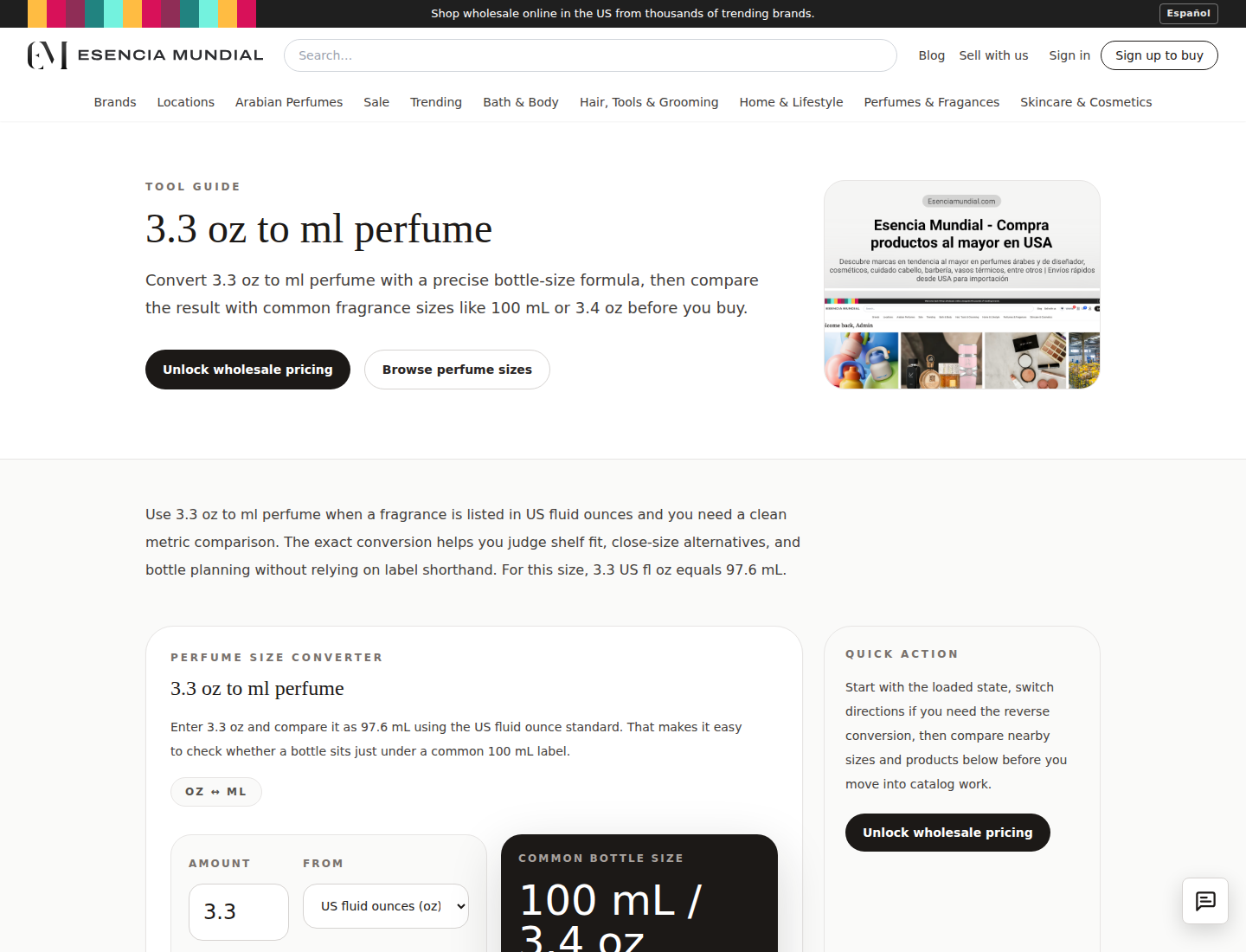
If the structure looks promising but you still do not trust the drydown, treat size as part of the risk. Compare common bottle sizes before you pay for more volume than your confidence justifies.
How should assortment breadth and depth be planned?
Many retailers learn this lesson after tying too much cash into a handful of scents that looked like obvious winners. In fragrance, the first buy should usually answer a learning question before it answers a scaling question.
A wider opening buy lets you test multiple demand paths at once: clean daytime profiles, sweeter evening profiles, gifting-friendly minis, and discovery-led testers. A deeper opening buy assumes you already know which path your shoppers will reward.
That principle aligns with how modern inventory systems are described by the major retail platforms in the published sources reviewed. Shopify emphasizes planning inventory levels around expected demand instead of intuition alone. Square's inventory work centers on turning data into profit rather than simply carrying stock. Lightspeed highlights visibility and sell-through control. Oracle extends the idea into enterprise discipline: inventory should move in step with purchasing and fulfillment decisions, not float separately from them. Those sources do not speak specifically to fragrance notes, but they strongly support the broader discipline of testing before scaling.
What does that mean in fragrance terms?
It means your first order should aim to learn across families, occasions, and formats. A spread of fresh daytime, versatile gifting, richer evening, tester-led discovery, and mini entry points usually teaches more than doubling down on one sexy description.
It also means each lane should have a different depth logic.
A proven mainstream lane in a familiar bottle size can support a bit more depth.
An exploratory lane with heavier base notes or a more niche identity should stay lighter until real conversion shows up.
A discovery lane should often be planned around access, not immediate full-bottle volume.
A retailer with limited cash is usually better served by carrying more decision options at controlled depth than by overcommitting to fewer narratives. That is especially true when multiple SKUs compete for the same occasion: date-night amber woods, office-safe fresh aromatics, and giftable daily florals can each look compelling on paper, yet only one may turn quickly in your customer mix.
The phrase some buyers need to hear is simple: a first buy is not a verdict. It is an experiment with financial discipline.
The benefit of a wider first buy is not only better learning. It is also better protection against the hidden cost of duplication. Fragrance buyers often discover, too late, that three supposedly different launches all solved the same shopper need. A broader, role-based opening position exposes more distinct hypotheses. You may learn that your customer base wants fresh clean office-safe fragrances and giftable minis, while the dense evening segment remains slower. That is far more actionable than discovering you bought three versions of the same warm evening promise.
Multi-location buyers gain an extra advantage from this approach. Breadth does not have to mean every location receives the same mix. It can mean the total buy covers multiple roles, while distribution reflects location strength. One store may carry deeper tester support for discovery-led families. Another may lean harder into giftable minis. A third may justify more standard-bottle depth in proven daily-wear lanes. The first buy becomes a structured field test rather than a one-size-fits-all commitment.
This is where collections become useful. Once you know you want saffron, amber, resin, rose, or oud, compare adjacent profiles inside Arabian perfumes instead of rereading generic note lists.
How should a retailer balance fragrance roles?
The biggest improvement in fragrance buying often comes when a team compares families side by side instead of evaluating each SKU in isolation.
Arabian collection: high intrigue, higher drydown uncertainty
An Arabian assortment often signals richer bases, more density, and a more distinctive identity. Even before naming any one fragrance, the family tells you something operationally important: the opening may attract curiosity, but the drydown is more likely to determine whether the shopper commits. That means the buying lesson is not "order aggressively because the family feels premium." The lesson is "support discovery before depth." For many retailers, that means limited initial full-bottle depth paired with tester availability or focused presentation in the Arabian collection.
What the opening-heart-base pattern proves here is that base-heavy families can create stronger emotional yes-or-no reactions. Inventory should respect that uncertainty.
Tester results can inform inventory planning when sampling is necessary, but selection, maintenance, and conversion measurement belong to the perfume tester guide. Inventory planning should use the resulting conversion signal without recreating the tester operating system here.
Minis can reveal lower-commitment demand, especially in gifting, travel, or discovery roles. Treat that signal separately from full-bottle sell-through and deepen only the format that earns repeat demand.
Standard 3.3 oz full bottles: depth belongs after proof. A standard bottle format is often where margin and presentation feel most complete, but it is also where misreads become expensive. A fragrance that sounds versatile because the opening is fresh can still underperform if the heart or base lands heavier than the audience expects. Before planning significant full-bottle depth, it is worth checking size comparisons through the 3.3 oz to ml perfume tool and confirming that the format fits both shelf strategy and customer appetite. The operating implication is that the full bottle is a scaling decision, not just a catalog default.
Put together, these four families show the heart of fragrance inventory planning. Opening notes may create attention. The heart shapes identity. The base decides how much conviction the shopper really has. Your format mix should follow that reality.
The comparison also highlights a useful decision rule. If the family is likely to be polarizing, reduce depth before you reduce assortment presence. In other words, keep a way for the customer to discover the lane, but do not let discovery-priced uncertainty masquerade as replenishment-grade demand. That single rule can prevent large, expensive mistakes in categories where curiosity is naturally stronger than commitment.
The same comparison helps store teams assign different proof thresholds to different families. An easy fresh lane might earn a faster reorder after one clean cycle because the shopper role is obvious and the trial barrier is low. A richer base-heavy lane might need stronger tester conversion, cleaner repeat behavior, or broader staff confidence before it earns the same treatment. The products are both fragrances, but they are not asking the business for the same amount of trust. Once buyers accept that difference, inventory planning becomes more proportional and far less vulnerable to overreaction.
How do size, packaging, and cash exposure change buy depth?
Retailers sometimes talk about fragrance as though the scent profile alone drives performance. In practice, inventory outcomes are often shaped just as much by bottle size, pack economics, and how quickly a unit can turn relative to its cash cost.
A larger bottle can look more attractive from a value perspective and still be the wrong opening position for a store with uncertain demand. A smaller entry format can appear less efficient on paper and still produce better inventory health because it lowers the barrier to trial and speeds turnover.
This is where adjacent sourcing surfaces become relevant. Broader trade and supplier directories such as Thomasnet and Wholesale Central help illustrate a basic market truth: packaging and supply format choices are part of inventory planning, not an afterthought. Likewise, data sources such as the U.S. Census Bureau can support broader market-context work when merchants need to understand regional retail patterns or business conditions, even though those sources do not tell you which scent will win.
The practical implication is simple. Fragrance buyers should separate three questions that are often blurred together.
What is the scent profile risk?
What is the format risk?
What is the cash-flow risk?
A fresh daily-wear fragrance in a full-size bottle may still deserve a shallower opening if the cash tie-up is heavy and the supplier lead time is manageable. A mini or tester may look less glamorous and still be the superior first move because it buys information at lower cost.
For merchants comparing standard bottle sizes, format conversion should be routine, not improvised. If the planning conversation is bouncing between ounces, milliliters, shelf count, and unit cost, buyers lose clarity. That is why a simple operational link such as the 3.3 oz to ml conversion tool belongs inside the workflow, especially when comparing full-bottle exposure against lower-risk formats.
Cash exposure should also be read alongside replenishment speed. A higher-cost bottle with dependable reorder cadence can be safer than a cheaper bottle with no clear role and slow conversion. Likewise, a mini with a lower ticket can be financially stronger if it turns quickly, drives gifting frequency, and builds a path into later full-bottle demand. The point is not to default to the smallest unit. It is to understand which unit buys the next layer of evidence most efficiently.
Packaging matters operationally too. Some formats are easier to display, easier to explain, easier to gift, and easier to replenish without awkward leftover stock. A buyer who ignores those realities may believe the decision was about notes, when the real issue was presentation friction or commitment mismatch. Fragrance planning gets better when the business acknowledges that bottles are not neutral containers. They shape trial, conversion, shelf allocation, and reorder timing.
How should a retailer forecast demand by assortment role?
The most reliable fragrance inventories are usually built around role-based demand rather than trend-chasing.
A role is the job the SKU does in the assortment. It might be the easy office-safe option, the giftable bestseller candidate, the richer evening statement, the discovery-led novelty, or the low-risk entry point.
When you plan by role, your forecast gets sharper because the assortment stops behaving like a pile of separate bottles. It becomes a system.
A practical role-based assortment might look like this:
| Assortment role | Typical scent behavior | Best opening format | Reorder posture |
|---|---|---|---|
| Daily fresh core | Fast first impression, broad appeal | Standard bottle plus limited tester support | Reorder earlier once repeat pattern is proven |
| Gift-friendly versatile lane | Easy to explain, low polarization | Standard bottle or mini | Watch seasonal lift and holiday timing |
| Rich evening lane | Stronger base, higher opinion split | Tester plus controlled full-bottle depth | Reorder only after clean sell-through |
| Discovery lane | Curious traffic, uncertain commitment | Tester or mini first | Let conversion justify scale |
| Price-entry lane | Lower commitment, browse-friendly | Mini or smaller format | Use to widen reach without overdeep buys |
This structure prevents one of the most common category mistakes: forecasting at the brand level only. A brand may be strong overall while one role inside the assortment is overstocked and another is underbought. Role-based planning catches that earlier.
It also helps with substitutions. If a fresh daily core is out of stock, the correct substitute is another easy daily core, not simply the next popular fragrance. Similarly, if a richer statement scent is unavailable, a gift-friendly soft floral may not protect the same demand.
This is where data from platforms like Square and Lightspeed becomes operationally valuable. Their broader inventory frameworks support organizing stock around how products move and what they are for, not just what they are called. That is exactly the mindset fragrance merchants need.
A role-based forecast is also easier to review after the fact. Instead of asking whether a product succeeded, the buyer can ask whether the role was correctly staffed. Did the daily fresh lane have enough breadth? Did the gift lane skew too premium? Did the discovery lane attract browsing but fail to convert because it lacked testers? Those questions lead to better next orders because they diagnose the assortment, not just the individual SKU.
Seasonality also becomes easier to manage when roles are explicit. Warm-weather planning may justify more visibility for fresh daily and low-commitment gift formats, while cooler months can tolerate more evening density and holiday-oriented minis. The key is that those shifts should happen inside a role framework rather than as random trend reactions. When buyers forecast by role, they can flex assortment without losing the logic that keeps the category profitable.
For multi-location retailers, role planning makes allocation more disciplined. One store may need a stronger gift lane. Another may earn deeper evening inventory. A third may serve as the discovery-heavy location where testers and minis do more of the work. When every product is mapped to a role, those differences are easier to manage without turning the assortment into chaos.
Role planning also gives merchants a clearer answer to the central inventory question. The problem is not that fragrance demand is impossible to forecast. The problem is that many buyers forecast against the wrong unit of analysis, usually a brand story or a description. The solution is to forecast against shopper roles, format logic, and evidence thresholds. Once those three are in place, hype loses much of its power to distort buying.
Which mistakes create avoidable fragrance overstock?
Most costly fragrance misreads are not sophisticated forecasting errors. They are repeated judgment errors.
The first is buying deep on a note list. A fragrance description can be elegant and still leave too much uncertainty for a heavy opening order. Notes should help you sort, compare, and stage risk. They should not create false certainty.
The second is ignoring the drydown when planning full-bottle depth. Many merchants behave as though the first impression is the whole selling story. In fragrance, the base often decides whether trial becomes purchase. When the base is richer, sweeter, woodier, or more assertive than the opening suggests, testers and minis become far more important.
The third is treating all formats as equivalent demand signals. A mini sale does not prove the same conviction as a full-bottle reorder, but it does prove something useful. It may show category interest, gift demand, or willingness to experiment. Likewise, tester engagement is not revenue by itself, but it can be a leading indicator when interpreted alongside conversion.
The fourth is overloading one occasion. Stores often drift into too many evening ambers, too many safe fresh options, or too many giftable florals because those clusters sound commercially comfortable. Balanced inventories require contrast, not just repetition inside the familiar lane.
The fifth is reordering off excitement rather than thresholds. A few good days, strong compliments from staff, or hype around a scent family can all tempt a premature reorder. Better practice is to wait for the indicator that matters: clean sell-through plus evidence that the product is solving a stable role in the assortment.
The sixth is separating merchandising from purchasing. If the purchasing team is not learning from how testers, minis, and full bottles convert differently, it is planning blind.
The seventh is forgetting that source quality affects planning quality. A fragrance category built from unclear sourcing, inconsistent format data, or weak catalog information becomes harder to forecast with confidence. That is one reason merchants benefit from staying close to verified first-party category surfaces like Perfumes & Fragrances, our fragrance brands, and clean format utilities.
These errors usually show up together. A buyer overreads notes, buys too deep in full bottles, neglects testers, and then explains the outcome as unpredictable. Often it was not unpredictable. It was under-structured.
A practical fix is to answer one operational question before every meaningful buy: what evidence would make this reorder safer than the first order? If the team cannot answer that, it usually means the opening order is too deep or too vague. Good inventory planning begins by defining the future proof required for scale.
Another useful correction is to separate beauty from utility in the buying conversation. Beautiful packaging, prestige branding, and fashionable notes may justify trying a fragrance. They do not justify granting it a protected role or deep initial allocation. Those privileges should be earned by demand behavior, not by a persuasive story.
How should inventory planning use the first test order?
Use the first order to test a limited set of assortment roles, then let sell-through and repeat behavior determine depth. The first wholesale perfume order guide covers opening-order composition; this page owns the replenishment and reorder rules that follow.
When should a fragrance earn a deeper reorder?
Opening orders matter, but reorder behavior is where inventory quality compounds.
A poor fragrance reorder happens when the buyer responds to noise: one good weekend, a loud staff favorite, a social-media bump, or the feeling that a premium-looking scent must stay deep in stock.
A better reorder happens when the buyer responds to evidence in sequence.
Was the product tried?
Was it purchased after trial?
Was the format mix healthy?
Did the product repeat in a way that suggests routine demand rather than novelty?
Did it protect a real role in the assortment?
The published sources reviewed supports this broader discipline even if it does not supply a fragrance-specific formula. Shopify, Square, Lightspeed, and Oracle all reinforce versions of the same operating truth: inventory decisions work best when they are planned, tracked, and integrated rather than improvised.
That means a fragrance merchant should know in advance what will trigger a deeper reorder.
Examples of sensible triggers include two clean sell-through cycles in the same role, consistent conversion from tester or mini into full bottle, or visible resilience outside a promotional window.
Examples of weak triggers include staff excitement, beautiful packaging, or one strong first impression from a note list.
A simple reorder checklist helps.
| Reorder checkpoint | Yes means | No means |
|---|---|---|
| The product filled a distinct role in the assortment | It earned space on function, not novelty | It may be duplicating another SKU |
| Trial converted into purchase | Scent experience matched description well enough | Interest may be higher than commitment |
| Full-size sales were not fully dependent on discounts | Demand may be sustainable | Margin may be doing the selling |
| Performance held across more than one cycle | Reorder can be less defensive | Keep exposure controlled |
| Comparable products are not piling up nearby | Depth will not worsen duplication | Assortment clean-up may be needed first |
One of the clearest ways to operationalize this is laddered replenishment. The first reorder should not automatically be a dramatic one. If a product proves early demand, the next buy can step up moderately while the team watches whether conversion quality survives without novelty momentum. A later reorder can deepen more aggressively only after the SKU has shown that it belongs in the assortment on function, not mood. That stepwise approach keeps the solution aligned to the original problem: do not buy certainty before the business has earned it.
This is also the point where cleaner first-party browsing matters. A merchant comparing adjacent expansion options can move from the general blog hub into our fragrance brands or the broader Perfumes & Fragrances category without losing track of the format logic that shaped the original plan.
Strong reorder discipline also improves negotiations and vendor expectations. When suppliers know the business scales based on role clarity, conversion quality, and repeat evidence, the conversation becomes more commercial and less emotional. That protects the buyer from overbuying on launch pressure or prestige bias.
The ultimate goal is not rigid caution. It is earned aggression. Once a scent family proves that it fills a role, converts after trial, and repeats cleanly, the business should be willing to back it. The discipline comes from knowing exactly why it has earned that support.
A final discipline worth adding is post-reorder review. Teams often evaluate the opening order carefully and then treat the first reorder as confirmation enough. A stronger habit is to review whether the larger position actually improved category health. Did it shorten stockouts in a real role, or did it quietly create excess in a lane that had only temporary momentum? That follow-up matters because the solution is not merely to reorder later than before. It is to reorder with evidence strong enough to survive a larger bet.
How should a retailer choose between two inventory options?
When two fragrance buys look equally promising, the better choice is rarely the one with the prettier description. It is the one whose uncertainty is easier to manage.
Choose the scent family that fills a cleaner role in the assortment.
Choose the format that buys the next layer of learning at the lowest reasonable cost.
Choose the product whose opening, heart, and base create fewer unanswered questions for your actual customer mix.
Choose the lane where reorder rules are already visible.
And if the uncertainty remains high, do not force a heroic full-bottle decision. Let testers, minis, or shallower depth carry the learning burden first.
That is the shortest path to better fragrance inventory planning. Notes help, but only when they are used as directional clues. Formats matter, because they convert curiosity into safer evidence. Reorders matter most of all, because they are where good taste stops being guesswork and becomes category management.
For retailers building fragrance with discipline, the winning move is rarely buying more confidence. It is designing a system that needs less of it.
Every fragrance order should answer a business question: Is this lane worth expanding? Is this family better suited to testers or minis? Has this role earned deeper full-bottle exposure? Once the assortment is built around those questions, the category is easier to scale without confusing taste with proof.
Wholesale next step
Sign up to unlock wholesale pricing so you can compare the shortlist inside your buyer account instead of guessing from the public catalog alone.
Need a fast second opinion before you commit? Chat on WhatsApp, contact us by email, or contact us here.
FAQ
How should a retailer balance fragrance assortment breadth and depth?
Use breadth to test distinct customer needs and fragrance roles, then add depth only to products that prove demand. Several similar scents create more cash exposure without teaching the retailer much about the assortment.
When should a fragrance earn a deeper reorder?
A fragrance should earn a deeper reorder after sell-through and repeat behavior show that demand is durable. Review the remaining stock, sales pace, and role in the assortment before increasing quantity.
How do bottle size, packaging, and case packs affect buy depth?
Larger bottles, bulky packaging, and fixed case packs use more cash and shelf space per decision. Buy depth should reflect that exposure as well as the product's expected sales pace.
How should inventory planning use the first test order?
Use the first order to test a limited set of assortment roles. Let sell-through, repeat demand, and stock on hand determine which products deserve replenishment or a deeper position.
Which mistakes create avoidable fragrance overstock?
Avoidable overstock usually comes from duplicating similar roles, buying too deeply before demand is proven, and reordering from enthusiasm instead of sales evidence.