
How to Calculate Perfume Profit Margin for Resale
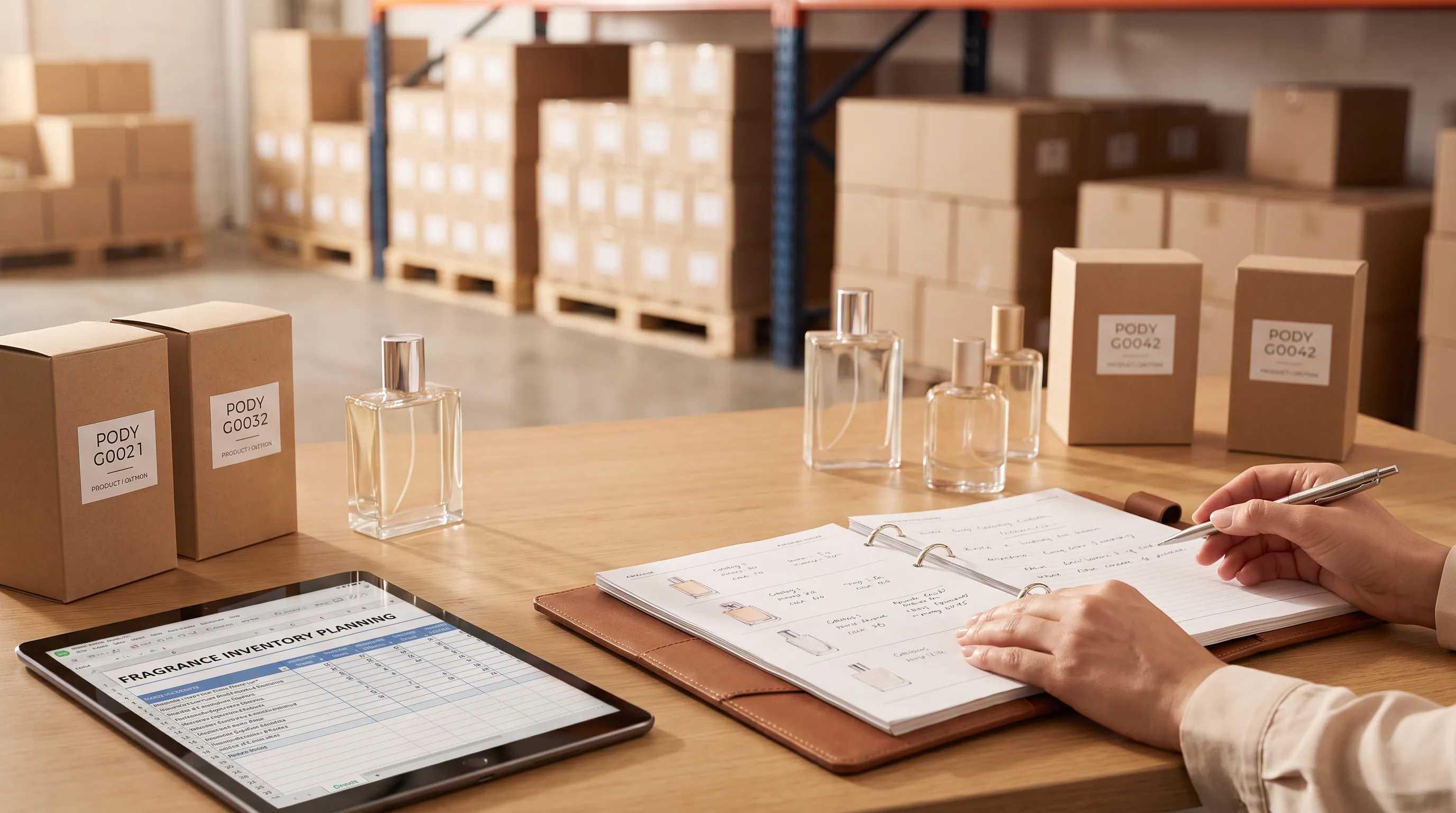
To calculate gross product margin on perfume, subtract the landed cost per sellable bottle from the product selling price after discounts, then divide by that price and multiply by 100. Exclude sales tax collected for remittance from the price. Markup uses cost as its denominator; contribution margin also deducts direct selling costs to show the share of net sale revenue available for overheads and profit.
Key takeaways
- In the hypothetical example below, a bottle with a $16 landed cost sells for $30 before sales tax, with no separate customer shipping charge. A 10% fee on the product price and $4 in fulfillment are its only direct selling costs, leaving $7 in contribution, or 23.3% of revenue.
- A larger order can reduce cost per bottle, but the saving must be weighed against the extra cash committed and the time needed to sell the stock.
- Test your target price against comparable offers and expected sales volume, then check whether total contribution can cover overheads.
Calculate landed cost per sellable bottle
Start with the purchase price and add the costs of getting stock to you: allocated inbound freight, applicable duties, handling and purchase taxes you cannot recover. Calculate the result for each exact SKU. Different bottle sizes, concentrations and gift-set formats can have different purchase prices and freight allocations. Nunu Trading
A hypothetical 40-bottle order
A retailer orders 40 identical bottles at $15 each and pays $40 in inbound freight. All 40 arrive sellable, with no other acquisition costs or unrecoverable purchase taxes.
The bottles cost $600; adding freight brings the order cost to $640. Dividing by 40 gives a landed cost of $16 per bottle.
Use $16, rather than the $15 invoice price, as the starting cost for the sale calculation.
For a mixed shipment, allocate shared charges on a basis that reflects how the charge is incurred, then check that the allocations add back to the bill. In a separate hypothetical shipment, suppose a $40 freight bill is allocated by shipped weight: SKU A accounts for 20 lb and SKU B for 60 lb. A receives $40 × 20 ÷ 80 = $10; B receives $40 × 60 ÷ 80 = $30.
If A contains 10 sellable bottles bought for $12 each, its landed cost is ($120 + $10) ÷ 10 = $13 per bottle. If B contains 15 sellable bottles bought for $15 each, its landed cost is ($225 + $30) ÷ 15 = $17 per bottle. This example assumes no other acquisition costs.
Now suppose two bottles from the original $640 order arrive unsellable and the loss is not reimbursed. The planning cost becomes $640 ÷ 38, or about $16.84 per sellable bottle. That already accounts for the two lost bottles, so do not deduct the same loss again. Subtract any reimbursement for the loss before calculating the revised unit cost. Formal inventory accounting can treat the loss separately. ScentSource Global
Calculate gross margin, markup and contribution
Gross product profit is the net product price minus landed cost. Gross product margin divides that profit by the net product price; markup divides it by landed cost. Both percentages use the same profit but answer a different question. Mahsons Wholesale
To calculate contribution, start with net sale revenue: the discounted product price plus any separately charged shipping retained by the retailer, excluding sales tax collected for remittance. Subtract landed product cost and direct selling costs. Divide the remainder by net sale revenue and multiply by 100 for the contribution margin. Include a customer’s delivery charge in revenue and deduct your actual delivery cost separately.
Continue with the hypothetical $16 bottle. It sells online for $30 after discounts and before sales tax, with no separate shipping charge. The fee is 10% of the product price, outbound shipping and packaging cost $4 together, and there are no other direct costs.
Hypothetical online sale of one bottle
| Item | Calculation | Result |
|---|---|---|
| Net sale revenue | Product price after discounts, before sales tax | $30.00 |
| Landed cost | $640 order ÷ 40 sellable bottles | −$16.00 |
| Gross product profit | $30.00 − $16.00 | $14.00 |
| Gross product margin | $14.00 ÷ $30.00 | 46.7% |
| Markup | $14.00 ÷ $16.00 | 87.5% |
| Selling fee | 10% × $30.00 | −$3.00 |
| Outbound shipping and packaging | Hypothetical cost per order | −$4.00 |
| Contribution | $30.00 − $16.00 − $3.00 − $4.00 | $7.00, or 23.3% of revenue |
The $7 contribution still has to cover expenses such as rent, software, insurance and wages; it is not the business’s net profit. Include other direct costs, such as advertising attributable to the sale, when they apply.
Run the calculation separately for each channel. In a hypothetical in-person sale at the same $30 price, a 3% card fee and a $1 bag would leave $12.10, or 40.3%, assuming no other direct costs. A shop may also need to account for testers or other selling costs. ScentSource Global
Use your actual fees, shipping and return costs
Check the base for each fee. Some platforms calculate it on the customer’s entire payment, including shipping or sales tax. For example, if a hypothetical platform charges 10% of a $37 payment—$30 for the product, $5 for shipping and $2 in sales tax—the fee is $3.70. Net sale revenue is $35 because the $2 tax is collected for remittance. Mahsons Wholesale
Include any tax you cannot recover on fees, shipping, packaging and advertising; exclude tax you can recover. To replace the hypothetical $4 fulfillment cost, obtain a quote for a carrier service that accepts the fragrance on your intended route and include the applicable packaging costs.
You can estimate a return adjustment from your own records. If your starting model records the original revenue and landed product cost for every order before returns, calculate: (pretax refunds, including any shipping refunded + additional return costs − recovered fees − landed cost of items returned to sellable stock) ÷ the number of original orders. Subtract that average once from contribution per order, using orders and returns from the same period or sales cohort.
If your revenue figure already excludes refunds, leave those refunds out of the adjustment. Likewise, do not subtract recovered product cost twice or add arrival damage again if it is already included in your cost per sellable bottle.
Set a price for a target contribution margin
When the selling fee is a percentage of the same net price used for revenue, work backward from a target:
Required price = (landed cost + fixed direct selling costs) ÷ (1 − percentage selling fee − target contribution margin)
Express percentages as decimals. With a $16 landed cost, $4 in fixed fulfillment costs, a 10% fee and a 25% target, the calculation is $20 ÷ (1 − 0.10 − 0.25) = approximately $30.77. That leaves about $7.69 in contribution, or about 25% of the price. Rounding prices and fees to cents can change the result slightly.
This formula assumes no separately charged shipping revenue or other price-linked costs, and the fee and target must add to less than 100%. If a fee uses a different base, model that base separately. Setting the target to zero gives a direct-cost break-even price of about $22.22 in this example, leaving nothing toward overheads.
To judge a target, connect contribution to expected volume. If this were your only product, monthly overheads were $700 and contribution remained $7 per bottle, 100 sales would cover those overheads before operating profit. For several SKUs, multiply expected sales of each by its contribution per sale, then compare the combined amount with overheads and your desired profit.
Recalculate discounts and bundles
A discount reduces revenue while some costs stay fixed. In the original online example, 10% off the $30 price brings revenue to $27 and the 10% selling fee to $2.70. After the $16 bottle and $4 fulfillment cost, contribution falls from $7 to $4.30, or 15.9% of revenue.
A bundle can share fulfillment costs across bottles, but its lower price also changes the contribution. The following hypothetical comparison uses the same $16 landed cost per bottle and 10% fee on product revenue, assumes no separate customer shipping charge or other direct costs, and uses $6 to fulfill one larger bundle order.
Three separate orders compared with one bundle
| Offer | Order revenue | Landed product cost | 10% selling fees | Fulfillment | Contribution |
|---|---|---|---|---|---|
| Three separate bottles at $30 each | $90.00 | $48.00 | $9.00 | $12.00: three orders at $4 each | $21.00 total |
| Three-bottle bundle at $75 | $75.00 | $48.00 | $7.50 | $6.00 for one larger order | $13.50 total |
The bundle contributes $7.50 less across three bottles under these assumptions. With enough inventory, 27 separate single-bottle orders would contribute $189; 14 bundle orders would also contribute $189 but require selling 42 bottles. That is 15 more bottles, or 55.6% more, to match the same total contribution. This is a volume comparison; it does not predict demand.
Compare order quantities before buying
A lower quantity-tier price can improve contribution, while a larger order commits more cash. This hypothetical comparison assumes every bottle is sellable and uses the same $30 sale price, 10% fee and $4 fulfillment cost per bottle sold.
Two hypothetical order sizes
| Order | Upfront cost including freight | Landed cost per bottle | Contribution per bottle sold |
|---|---|---|---|
| 40 bottles at $15, plus $40 freight | $640 | $16.00 | $7.00 |
| 100 bottles at $14, plus $50 freight | $1,450 | $14.50 | $8.50 |
The larger order requires $810 more upfront and saves $1.50 per bottle. After 40 sales, it would have produced $60 more contribution on those units, while leaving 60 bottles to sell.
If the purchase, customer payments, fees and fulfillment have all been settled, cash from those transactions is $280 for the 40-bottle order versus −$530 for the 100-bottle order, before overheads and other costs. The larger order still holds 60 bottles at a modeled landed cost of $14.50 each, or $870 in inventory.
For an untested fragrance, a smaller order can limit inventory exposure. A larger tier becomes more attractive when available cash and observed sell-through support it. Nunu Trading Use the fragrance inventory planning guide to connect sales pace with replenishment decisions.
Decide whether to buy, price or reorder
There is no single margin target that suits every perfume retailer. Compare your required price with offers for the same fragrance, size, concentration, condition and delivery terms. The example’s $30.77 target is useful only if customers will buy that exact product near the price and expected sales provide enough contribution for your business. Mahsons Wholesale
If the achievable price falls short, recalculate with a different acquisition cost, channel or order quantity, or reconsider the purchase. Start with a current quote for the exact fragrance, size, concentration, quantity and destination. For help assembling an order, see Wholesale Perfume Buying: Build a First Order.
After launch, track units sold, days available, discounts, returns, contribution and sellable stock by exact SKU and channel. Before reordering, compare stock on hand and confirmed incoming units with expected demand during the supplier’s lead time and your chosen buffer. Check when incoming stock is due, then size the reorder for expected demand through the next review period after delivery, adjusting for pack sizes, minimum quantities and available cash. ScentSource Global
Sources
How to Price Perfume for Resale in the UK | Mahsons Wholesale
Wholesale Perfume Margins: How to Calculate and Protect Them
Wholesale Perfume for Resale: Buyer Planning Guide | ScentSource Global